How to Diagnose a Slow Month in Your Service Business
Quick Answer
A slow month in a service business comes from one of four problems: demand dropped seasonally, people aren't finding you, people found you but didn't call, or leads called but didn't get booked. Pull your Google Business Profile performance report and compare views, searches, and calls over 30, 60, and 90 days. If views are steady but calls dropped, you have a conversion problem — not a visibility problem. Fix the right problem before spending anything.

The phone gets quiet, and the first instinct is to call the marketing company. “We need more visibility.” Maybe more ads. Maybe better SEO. Maybe a new website.
Sometimes that’s right. Often it isn’t.
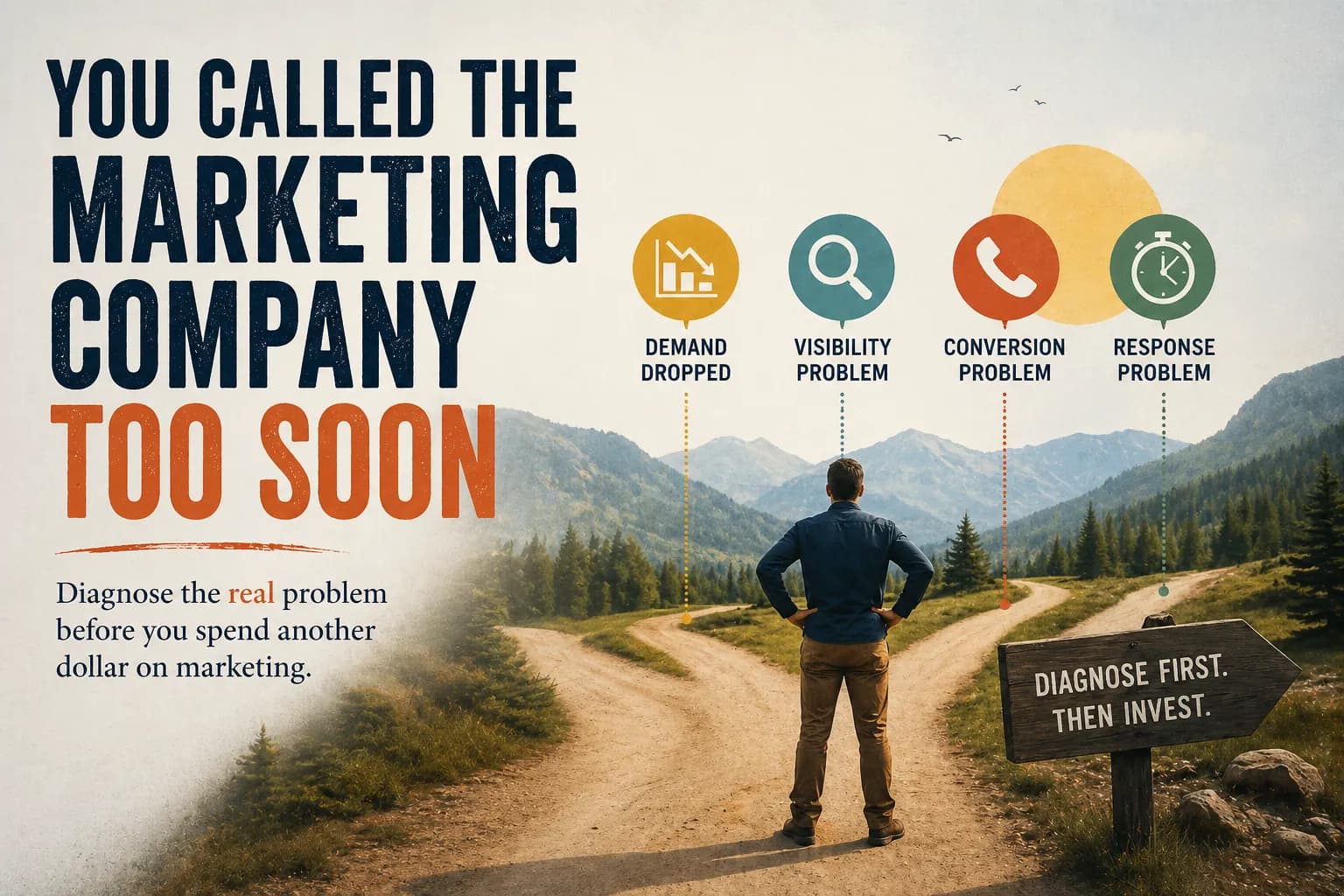
A slow month in your service business can come from four completely different problems — and only one of them is Google’s fault. Spending money before you know which problem you have is how service businesses burn through cash chasing the wrong fix.
Here’s the diagnostic most owners skip.
Four Reasons a Service Business Has a Slow Month
Before you write a check or call your ad rep, figure out which of these you’re actually dealing with.
1. Fewer people are searching. Demand dropped. The market quieted. This happens seasonally in almost every trade — and it’s normal. It does not mean your marketing is broken.
2. People are searching but not finding you. This is a visibility problem. Now you might have a Google issue.
3. People found you but didn’t call. This is a conversion problem. Weak photos, thin reviews, no clear offer, pricing confusion — something killed the trust before they picked up the phone.
4. People called but you didn’t book them. Slow response, missed calls, no follow-up. The lead came in and walked out the other side.
These four problems require four different solutions. Throwing ad spend at a conversion problem doesn’t fix it. Rebuilding your website when the real issue is demand timing wastes three months. The diagnostic matters.
Your Google Business Profile Already Has the Answer
Most owners don’t use this data, but Google Business Profile gives you a performance report that separates visibility from action. You can see views, searches, calls, website clicks, messages, and booking actions — all in one place. https://support.google.com
That distinction is everything.
If views and searches are holding steady but calls are down, you don’t have a visibility problem. People are finding you. They’re just not contacting you. That’s a conversion problem — weak photos, stale reviews, an offer that doesn’t match what they need right now, or a response friction they’re not willing to push through.
If views and searches dropped, that’s a different conversation. Either demand fell off (check seasonal patterns first) or something changed in how Google is ranking your profile for the searches that matter.
Pull 30, 60, and 90 days of data side by side. Look at what changed and when. The answer is usually in there before you spend a dollar.
Slow Months Are Seasonal. Most Owners Know This. Few Account for It.
Home service demand does not move in a straight line. It never has. “AC repair” searches climb sharply into summer. “Furnace repair” peaks in cold-weather months. Plumbing has spring and winter spikes. Roofing follows storm patterns and warm-weather project seasons.
The trades that struggle most with slow months are usually the ones treating every dip like a crisis instead of reading the demand calendar.
If your HVAC company is quiet in April, that might be exactly what April looks like for HVAC companies. The smarter move isn’t to panic and buy more ads — it’s to shift the offer toward pre-season tune-ups, AC checks, and maintenance plan signups. You’re not chasing emergency calls that don’t exist yet. You’re building the pipeline for when the calls do come.
Know your demand curve. Then match your offer to where you actually are in it.
Visibility Is Service-Specific — Not a Single On/Off Switch
Here’s something that trips up a lot of owners: you can be visible for one search and invisible for another.
Google’s local results are shaped by relevance, distance, and prominence. Relevance means how well your profile matches what someone typed. A plumber who has solid coverage for “plumber near me” may be weak on “water heater repair” or “drain cleaning” — and those are the jobs they actually want.
If you’re slow, it’s worth checking which searches are actually finding you. A profile that gets seen for broad terms but not for specific high-value services has a targeting problem, not a total visibility problem. The fix is service-specific — better service pages, photos tied to those jobs, posts and review language that mentions the work by name.
That’s a very different fix than “we need more SEO” as a general concept.
What a Slow Month Looks Like for a Roofer
A roofer sees a slow stretch and assumes their Google ranking dropped. But their Business Profile views are steady — maybe even up from last month.
So why are calls down?
People are seeing the profile and moving on. That’s a conversion problem. The likely culprits: outdated photos that don’t show recent work, reviews that are six months old, no mention of storm damage repair or financing, nothing to signal that this company can move fast on an insurance job.
The fix isn’t more ad spend. It’s making the profile earn the call once someone gets there. Better photos. Fresher reviews that mention specific jobs. A clear offer for what’s in season right now.
More budget pointed at a profile that isn’t converting just sends more people to the same dead end.
Response Speed Is a Leak Most Owners Don’t Check
Assume for a moment that demand is healthy and your visibility is fine. People are finding you, they’re reaching out — and you’re still not booking enough work.
Over 70% of customers expect a same-day response. More than half expect to hear back within an hour. Jobber 2026 Home Service Trends Report
If your answer rate is low, if you’re returning calls hours later, if messages sit unanswered — you have an operational leak, not a marketing problem. The leads are there. They’re just not sticking. JObber 2026 Report
This is worth measuring before anything else. Check your call answer rate. Check how long it takes to call back a missed call. Check whether messages through your profile are getting replied to the same day. These numbers exist. Most owners don’t look at them until they’re already in a slow stretch trying to figure out what changed.
What to Actually Measure Before You Spend Anything
Run through this before you change a budget, rebuild a campaign, or hire anyone:
- Business Profile views over the last 30, 60, and 90 days — are they stable, rising, or falling?
- Search terms showing up in your GBP performance — what are people actually searching to find you?
- Action metrics — calls, website clicks, messages, bookings. Did these drop alongside views, or separately?
- Call answer rate and callback speed — are you actually catching the leads coming in?
- Service mix — which jobs are being searched for right now, and is your profile positioned for them?
- Seasonal demand patterns — is this month historically slow in your trade, for your services?
- Review recency — when did your last review come in, and does it mention the work people are currently searching for?
One diagnostic question ties all of it together: Did demand drop, did visibility drop, or did conversion drop after people found you?
Get clear on that before you do anything else. The right fix is cheap and fast once you know what broke. The wrong fix is expensive either way.
The Slow Month Isn’t the Problem. The Misdiagnosis Is.
Some seasonality is real and expected. You can’t ad-spend your way out of a market that isn’t searching yet.
But if the demand is there and you’re still slow, something specific broke down — and it’s findable. Google gives you enough data to see it. The profile performance report, the search terms, the action metrics — they tell you where the drop happened.
The owners who stay steady through slow stretches are not the ones with the biggest ad budgets. They’re the ones who know exactly which number changed, why it changed, and what to do about it before they write a check.
That’s the whole game.
Frequently Asked Questions
My schedule is slow — do I need to run more ads or fix my SEO?
Not necessarily. A slow month can come from four completely different problems, and only one of them is a Google issue. Demand may have dropped seasonally, people may be finding your profile and moving on without calling, or you may be missing leads after they've already reached out. Throwing ad spend at a slow schedule before knowing which problem you have is how service businesses burn cash on the wrong fix. Next step: Before calling your ad rep, open your Google Business Profile performance report and compare views, searches, and calls over the last 30, 60, and 90 days to see where the drop actually happened.
What's the first thing I should check before I spend money on marketing?
Check your Google Business Profile performance report. It shows views, searches, calls, website clicks, and booking actions — all in one place. If your views and searches are holding steady but calls dropped, people are finding you and moving on, which means something on your profile isn't earning the call. If views dropped alongside calls, that's a different problem worth digging into. Next step: Pull 30, 60, and 90 days of GBP data side by side and look for where the numbers split — that's where your problem lives.
I'm a one-truck operation always in the field. What's the one thing I can actually check from my phone?
Open your Google Business Profile and look at views versus calls. If views are holding but calls dropped, your profile isn't closing once people get there — think outdated photos, stale reviews, or no clear offer for what's in season right now. If both views and calls dropped, check whether this month is historically slow for your trade before assuming something broke. The whole check takes 10 minutes and tells you whether to act or wait. Next step: Compare your GBP call count for this month against the same month last year — that one comparison will tell you if this is normal seasonality or something worth fixing.
How fast do I need to call someone back before they've already moved on?
Over 70% of customers expect a same-day response, and more than half expect to hear back within an hour. If you're returning missed calls hours later or leaving messages sitting until the next morning, the leads are walking — not because your marketing failed, but because your answer rate is the leak. This is worth measuring before you change your ad budget or touch your profile. Next step: Check your missed call log from the past two weeks and note your average callback time — if it's consistently over an hour, that's the first thing to fix.
When is it actually time to buy more ads instead of tightening things up?
When demand is real, your profile is earning calls, and your response speed is solid — and you're still not filling the schedule — then you have a volume problem and more ad spend makes sense. But ads work by sending more people to whatever's already there. If your profile has weak photos, thin reviews, and no clear offer for what people are searching right now, more traffic just means more people who don't call. Earn the call first, then scale the volume. Next step: Run through the four-part diagnostic — demand, visibility, profile performance, response speed — and only move to paid ads once you've confirmed the first three aren't the problem.
What's the one question that tells me what actually broke during a slow stretch?
Did demand drop, did visibility drop, or did people find you and not call? That single question separates three completely different problems that each require a different fix. Your GBP performance report gives you the data to answer it — views tell you about visibility, action metrics like calls and clicks tell you whether people are following through, and a quick look at seasonal patterns tells you whether this is the calendar or something you need to address. Next step: Ask yourself that question right now, then open your GBP report and find where the numbers changed first — that's your answer before you spend a dollar.
Want help finding the leak?
I’ll look at your lead handling, follow-up, pricing logic, and website path and show you where demand or margin is slipping out.
About the Author
Trevor Riggs helps owner-operated service businesses find and fix the places jobs leak out — weak Google visibility, missed calls, slow follow-up, thin reviews, underperforming websites, and wasted ad spend. He runs True Path Digital, a practical consulting and implementation business built around clearer decisions, better lead handling, and fewer missed opportunities.
Connect on LinkedIn