Missed Calls Are Lost Jobs: The Leak Every Home Service Business Should Measure
Quick Answer
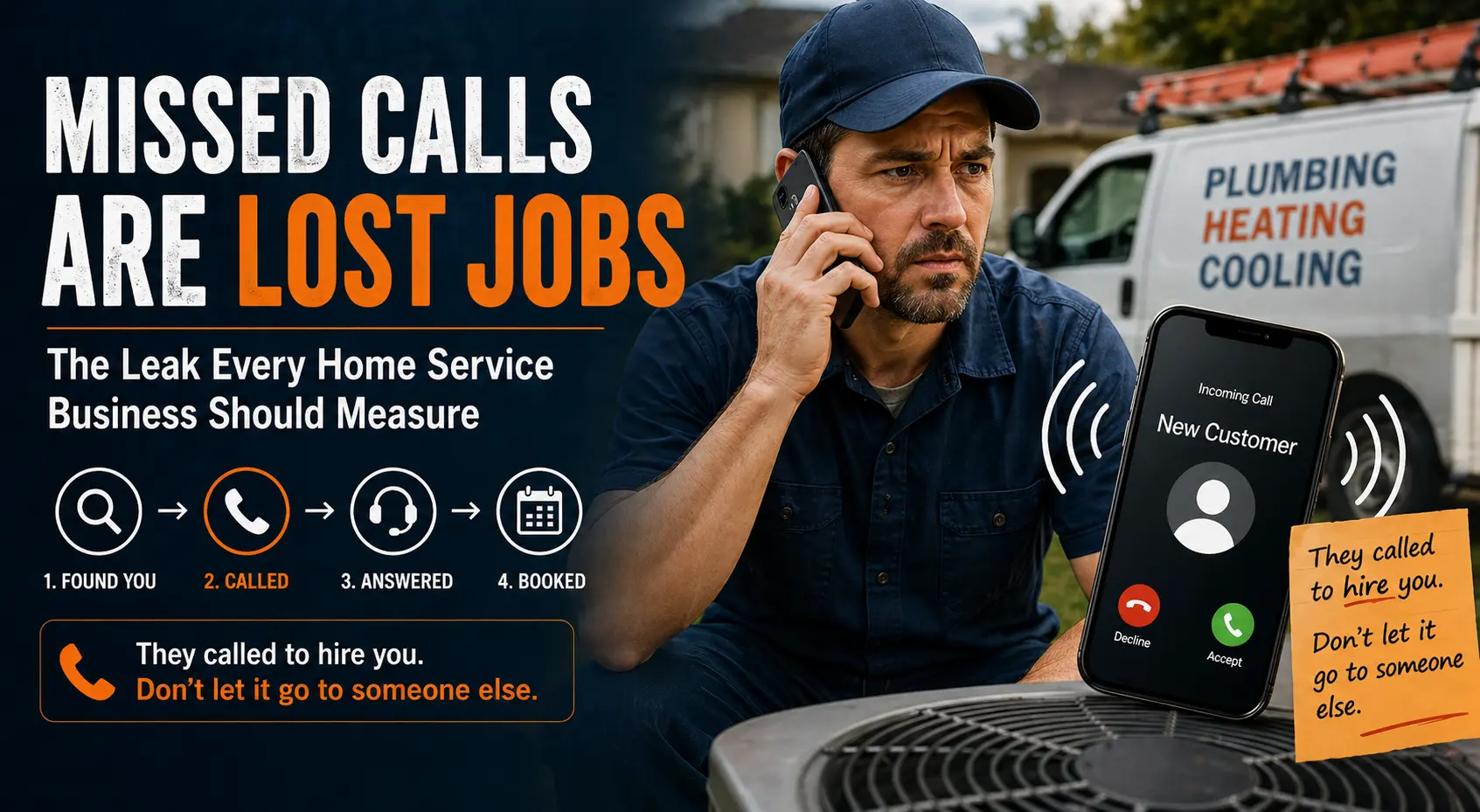
Home service businesses often lose jobs before they ever quote them because missed calls turn high-intent customers into someone else’s booking. Before spending more on ads or rankings, owners should run a 30-day call audit to see how many calls came in, how many were answered, how many were missed, and how fast callbacks happened. Since Google removed Business Profile call history, call tracking now has to be measured directly.

Before you spend more money getting the phone to ring, make sure the calls you already get are being answered, tracked, and turned into booked work.
The phone rings while you’re under a sink, on a roof, in a crawlspace, or standing in a customer’s driveway explaining a repair estimate. You miss it. You tell yourself you’ll call back when you get a minute.
The problem is, the customer may not be waiting for that minute.
A friend of mine was telling me last week he needed to spend more on marketing. His leads were drying up. Competitors were taking work he should’ve gotten. So I asked him a couple of questions: how fast do you answer your calls, and how do you answer them? He didn’t know. He’d never looked.
That’s the conversation I keep having. And it’s the gap most owners skip past on the way to blaming the ad budget.
Missed calls in a home service business are a revenue leak that sits between your marketing spend and your booked jobs, quietly costing you work you already earned the right to bid on. Most owners never measure it. They blame the marketing instead.
When Leads Dry Up, Most Owners Ask the Wrong Question
The instinct when business slows is to look at the top of the funnel. More ads, better rankings, a stronger Google presence. Sometimes that instinct is right.
But there’s a simpler question worth asking first: how many people already tried to hire you and couldn’t reach you?
If you only measure leads generated and never measure calls answered, you’re seeing half the picture. The leak might not be at the top of the funnel. It might be at the handoff.
The gap between “someone found you on Google” and “you booked the job” runs through several steps: they searched, they found you, they called, you answered, you booked. Each step is a place where demand can drain. The phone call is where most service businesses lose the most demand and measure the least about why.
What I Actually See Happen
Here’s the pattern I see when I look closely at how owners run their phone. The owner’s on a job. The phone rings. He sees it, can’t get to it, plans to call back at lunch. Lunch comes and goes. The afternoon slips. By the time he’s back in the truck driving home, it’s been four hours, and the call has gone cold.
When he finally calls the customer, the customer has already hired someone else.
It’s not that the owner doesn’t care. It’s that the work in front of him crowds out the work waiting on the phone, and three or four hours feels like nothing when you’re elbow-deep in a job. To the customer with a stuck garage door or a leaking pipe, three or four hours feels like a decision.
The customer made theirs. It just wasn’t you.
Why Missed Calls Hit Harder in Home Service
For most industries, a missed call is a minor inconvenience. The customer sends an email, fills out a form, or tries again later.
That’s not how it works in home service.
Someone calling a plumber, HVAC company, roofer, auto shop, or pest control company usually has a real problem in front of them. They aren’t casually browsing. They want to know if you can help, whether you’re available, and how soon you can get there. The call is the decision point — the research is already done.
When you miss that call, the customer doesn’t think “they must be busy, I’ll wait.” They think “I need this handled. I’ll call the next company on the list.”
That next company doesn’t have to be better than you. They just have to answer.
How Missed Calls Affect Your Google LSA Ranking
There’s a secondary consequence that doesn’t show up in your voicemail.
Google’s Local Services Ads factor responsiveness into ranking. According to Google’s own documentation, one of the signals that affects where your ad appears is how likely it is to result in a lead, and missed calls can negatively affect that responsiveness score. [Insert link to Google Local Services Ads Help documentation]
If you’re running LSAs, a pattern of missed calls may not only cost you the customer in front of you. It may weaken the system bringing you future leads. Worth taking seriously as an operational metric, not just a customer service detail.
You Can’t Measure What Google Stopped Reporting
Here’s the compounding problem: Google used to give Business Profile users access to call history — a basic log of calls coming through Search and Maps. As of July 31, 2024, that feature is gone. Google still sends calls through your profile, but the call history inside the dashboard no longer exists.
For a lot of owners, that was a thin reporting tool to begin with. But it was the only place most of them ever looked. Now they’re working off assumptions.
How many called, how many got answered, how many left without leaving a voicemail — if you aren’t tracking it through your own system, you don’t know.
What Missed Call Data Actually Shows
Vendor data from Invoca, which sells call analytics software, suggests home services businesses may miss more than a quarter of inbound calls. Even if your operation misses far fewer than that, the math gets uncomfortable fast.
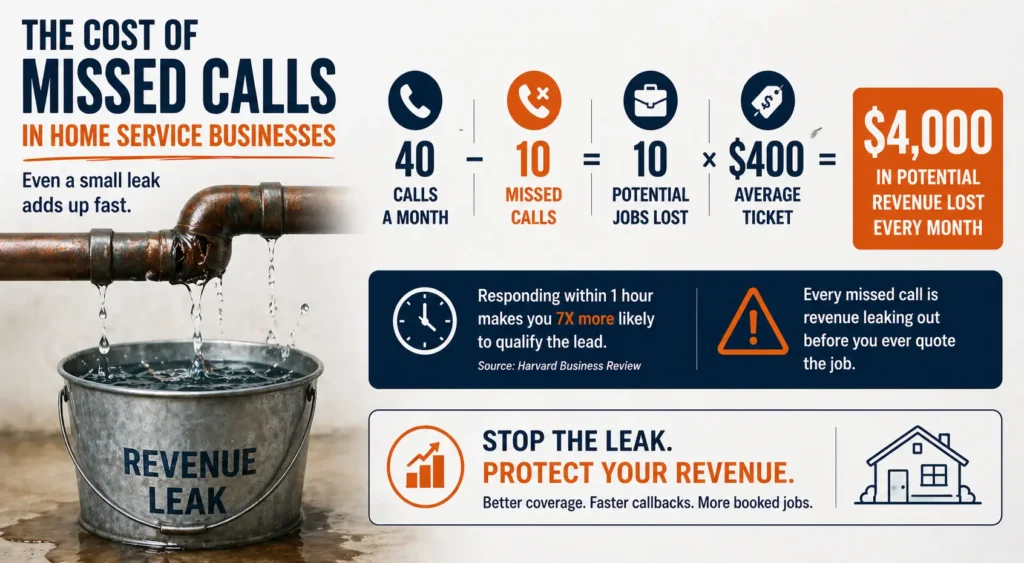
If your marketing generates 40 calls a month and you’re missing 10 of them, that’s 10 potential jobs that never got a shot at your pitch. At an average ticket of $400, that’s $4,000 in potential revenue draining out every month before you ever quote a single job.
The research on response time is equally uncomfortable. Work from Harvard Business Review found that companies responding to leads within an hour were nearly seven times more likely to qualify those leads than companies that waited longer. Delay doesn’t just lose conversions. It lowers intent. The longer someone waits, the more likely they are to keep looking.
How Missed Calls Drain Revenue by Trade
The pattern is the same across trades, but the urgency lives in different places.
In HVAC, the first hot week of summer is a sprint. The company that answers first gets the appointment. By the time you call back, the customer has either already booked someone else or booked you and three competitors and is planning to cancel two of the callbacks.
For plumbing, urgency is structural. A leaking pipe doesn’t wait. Neither does the customer.
Roofing demand spikes exactly when your crews are hardest to reach — during storm damage events, when phones blow up faster than anyone can answer them. Every missed call in that window is a job that goes to whoever picked up.
Auto repair runs on trust before the vehicle ever reaches your bay. A check engine light or a no-start situation is a decision the customer makes about who to trust, not just who’s available. If the shop doesn’t pick up, that decision starts forming around whoever did.
Garage door is the simplest case. If the door’s stuck open, the customer wants the first competent person who can help. Usually that’s whoever answers.
Why “Just Hire an Answering Service” Doesn’t Actually Fix It
The default answer to missed calls is “hire an answering service.” I don’t like that answer.
Most answering services feel sterile. The voice on the other end says “Can I help you?” and what they actually mean is “I’m here to take a message.” The customer hears the difference.
A homeowner calling a plumber at 9 a.m. on a Tuesday isn’t trying to leave a message. They want to know if you can come out. They want to hear that someone competent is on it. A scripted intake voice doesn’t deliver that. It just collects information and sends a callback ticket to your phone.
You haven’t fixed the missed call. You’ve delayed it.
What works is something in between. A real person who knows enough about the trade to talk to a customer like a peer, ask the right questions, and reassure them that the owner is on a job and will call back soon — but in the meantime, here’s what they should do. That’s not an answering service. That’s a trained handler. The difference is real, and the customer hears it on the first sentence.
Run a Call Audit Before You Spend More on Ads
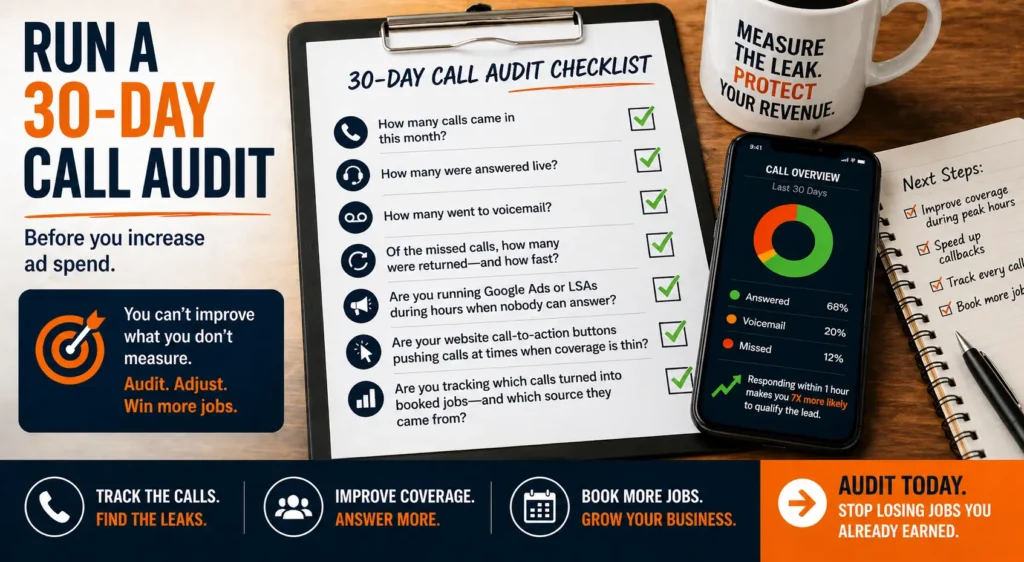
Before you increase your marketing budget, run a basic 30-day call audit. This doesn’t require software. It requires honest tracking of what’s actually happening at the phone.
Questions worth answering:
- How many calls came in this month?
- How many were answered live?
- How many went to voicemail?
- Of the missed calls, how many were returned, and how fast?
- Are you running Google Ads or LSAs during hours when nobody can answer?
- Are your website’s call-to-action buttons pushing calls at times when coverage is thin?
- Are you tracking which calls turned into booked jobs, and which source they came from?
Most owners don’t have clean answers to more than two or three of these. That’s the starting point. You can’t build a coverage plan around hours and sources you can’t see.
The Real Fix
More leads aren’t always the answer.
Sometimes the smarter move is to stop losing the demand you already earned — through better coverage during high-leak hours, faster callbacks when calls do get missed, and someone trained to talk to your customers like a peer when you can’t pick up yourself.
The fix isn’t “just answer every call.” Most owners can’t, and pretending otherwise isn’t useful. The fix is building a coverage plan that respects how your business actually operates: the hours you’re in the field, the times demand spikes, the gaps where jobs slip through, and the voice that picks up when you can’t.
If you’re going to bring in help to handle the phones, train them. Don’t outsource to a script reader. The customer can tell.
Frequently Asked Questions
My leads have been slow — should I be running more ads or improving my Google rankings?
Before you increase spend, the article makes a strong case for auditing what happens after someone finds you. If you don't know how many calls came in, how many got answered, and how many turned into booked jobs, you don't actually know where the leak is. The problem might not be that fewer people are finding you — it might be that they're calling and not getting through. More ads into a phone that isn't being answered just accelerates the drain. Next step: Pull your last 30 days and write down how many calls you got, how many you answered live, and how many missed calls you actually returned — before you touch your ad budget.
What should I fix before I put more money into Google Ads or Local Services Ads?
Run a basic call audit first. The article walks through the specific questions: how many calls came in, how many were answered live, how many went to voicemail, how fast were missed calls returned, and whether you're running ads during hours when nobody's available to pick up. Most owners can't answer more than two or three of those cleanly. That gap is your starting point — not your ad settings. Next step: Map your current call coverage hours against your peak inbound call times, then identify the windows where demand is highest and coverage is thinnest.
I'm in the field all day and I can't always answer — how bad is it really if a customer has to leave a voicemail?
For most trades, worse than you think. Someone calling a plumber or HVAC company isn't browsing — they have a real problem in front of them and they want to know if you can help and how fast. When you don't answer, the article puts it plainly: the thought isn't "they must be busy, I'll wait." It's "I'll call the next company on the list." That next company doesn't have to be better. They just have to pick up. Next step: Identify your highest-demand hours by trade season (first hot week, storm events, Monday mornings) and build a coverage plan specifically around those windows — whether that's a dispatcher, an answering service, or a crew member assigned to calls.
I missed a call and they didn't leave a voicemail — is it worth trying to call back?
Yes, and speed matters more than most owners realize. The article cites Harvard Business Review research finding that companies responding to leads within an hour were nearly seven times more likely to qualify those leads than those who waited longer. Delay doesn't just reduce your close rate — it reduces the customer's urgency. The longer they wait, the more likely they've already booked someone else or moved on. Next step: Set a rule for your shop — any missed call gets a return call within one hour during business hours. Even a quick "Hey, I saw I missed your call — what can I help you with?" closes the gap before they give up on you.
How does missing calls affect my Local Services Ads — or does it only hurt me with the customer in front of me?
It can affect both. The article points to Google's own documentation: responsiveness is a factor in where your Local Services Ads appear. A pattern of missed calls can weaken your responsiveness score, which may push your ad lower — meaning you're paying to run ads that fewer people see, partly because you didn't answer the calls the ads already generated. It compounds the problem instead of just reflecting it. Next step: Check whether your LSA hours match the hours you can actually answer. If you're showing ads at 7am but nobody's on phones until 8, either adjust the ad schedule or add coverage for that window.
What's the one number I should be tracking to know if I have a missed call problem?
Your live answer rate — how many inbound calls you actually picked up versus how many came in total. The article references vendor data from Invoca suggesting home services businesses may miss more than a quarter of inbound calls. Even if you're well below that, the math is uncomfortable: 10 missed calls a month at a $400 average ticket is $4,000 in potential revenue that never got a shot at your pitch. You can't fix a leak you're not measuring, and Google removed call history from Business Profile as of July 2024, so if you aren't tracking this yourself, you're flying blind. Next step: Set up a simple tracking sheet this week — log every inbound call, whether it was answered live or missed, and whether a missed call was returned. Run it for 30 days before drawing any conclusions.
Want help finding the leak?
I’ll look at your lead handling, follow-up, pricing logic, and website path and show you where demand or margin is slipping out.
About the Author
Trevor Riggs helps owner-operated service businesses find and fix the places jobs leak out — weak Google visibility, missed calls, slow follow-up, thin reviews, underperforming websites, and wasted ad spend. He runs True Path Digital, a practical consulting and implementation business built around clearer decisions, better lead handling, and fewer missed opportunities.
Connect on LinkedIn